
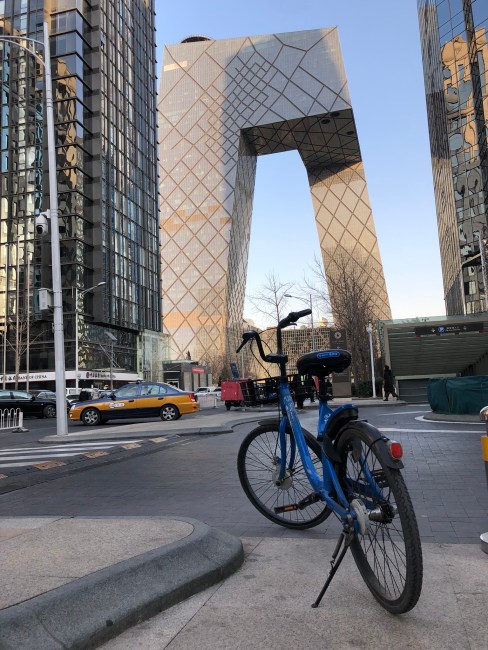
When I first lived in Shanghai in 2004, the single observation I’d go home to tell my friends in Singapore, was the noise pollution that plagued the city. The perpetual horning one hears from the cars on the street was so pervasive, so unrelenting, that when you slept, you could often hear the sound of the horns, if not from the streets, playing back in your dreams. Fast forward 14 years later. It is 9.30am a Monday morning. I am standing at a junction at Guomao, Beijing’s central business district. I cannot believe I can hear the caller speaking on my phone.
Among the most surprising things I have learnt since moving to Beijing in recent months, is how much more noise-free and orderly the streets in central Beijing have become. To be fair, I have had incidences of errant drivers honking with impatience (and condescension, I might add), but it is such a delight to stroll the streets today, that I had flashes of being in – don’t laugh – Tokyo in the evenings, when the one thing that struck me was how silent who whole city was.
China is indeed changing, and besides hearing it first hand, I am seeing it evolve in many ways, that perhaps the rest of the world could take a leaf out of its book for once. Here are five:
- Talk about a city with bad traffic, and Beijing quickly comes to mind. Even with a far-sighted design of its six-ring road infrastructure, a city synonymous with choking air after all, must have bad traffic. Well, maybe not so much anymore. Coming back to Beijing after half a decade – Beijing has added at least 10 more subway lines since I last remembered it. Its heavy-handed vehicle restrictions – digits on license plates on weekdays, non-Beijing cars entering the city and more – is now really starting to show some effect. The use of technology – car-sharing apps, and AI to unlock the city’s gridlock will only continue to uncover solutions that will no doubt be replicated across the country’s major cities.
- A city made for carbon-free vehicles – The other synonym that comes to mind about Beijing is the bicycle. Beijing, as with many of its major cities, was designed traditionally to accommodate its millions of commuters going about on two wheels. And thankfully, the government has not only kept the wide bicycle lanes intact, the introduction of bike-sharing facilities has made movement across the city smooth and even enjoyable. (There has been criticism too about the oversupply of poorly-constructed bicycles, resulting in immense wastage. I personally believe the cost-benefit analysis of managing waste will eventually fix the problem over time. Let’s see.).
- Use of plastics. Since its ban in 2008, local plastic bag use has already been on the downtrend for years. In stores and supermarkets, it somehow has never been much of an issue for locals to pack the groceries in their own bags, or purchase one if they really had to. People somehow got used to the law, and got with the programme. Eventually everyone saw the benefit of using less plastic bags. Coming from a small nation of five million inhabitants in which our party stronghold has not had the guts to enforce such regulations for fear of backlash, this is most unnerving.
Note: I will further document additional thoughts (in time to come!) on the areas in which China still has a long way to go to address plastics, and material use. Also of course, China’s recent ban on importing waste from Europe and the US, which has had significant impact on the rest of the world.
- Blue Air – “I’ve never seen Beijing like this. “, French President’s Macron famously quoted during his visit in 2018. To say that China has cleaned up its act on air pollution is at understatement today. Since 2013, the country’s draconian measures to combat air pollution has seen its city officials fight tooth and nail to meet Beijing’s target of 50% coal reduction in five years. Having witnessed the worst of China’s pollution myself in 2011- 2013, I have to say that the blue sky days are really a priceless commodity we in developed countries often fail to appreciate. Interestingly, households across modern China have been installing indoor air purifiers such as the BlueAir. There are even nifty little air pollution sensors that help detect pollution quickly. This has made living in China a lot more comfortable for families and sensitive individuals.
- Lastly, mindsets are also changing. I’ve been very heartened whenever I engage with peers in China about sustainability. In fact, the mention of sustainability is often met with enthusiasm, and the acknowledgement of the importance of being socially responsible. Whilst I do not pretend to understand the Chinese mindset well, I suspect that the learning systems in schools and the people’s desire to be regarded as a forward-looking society as a whole has a lot to do with it.
Safe to say, it has been a real eye-opener being in China once more, and witnessing such significant positive change unfolding before me. I will not pretend that China – the factory of the world and today the second largest economy in the word – has much more room to contribute to the world’s sustainability agenda, but I am positive that China will be a real driving force in this aspect in the years to come. And this time, I’d really like to be part of it.
 Little Roots in China